Program development
In order to develop Amplify Science as a program designed for three-dimensional instruction while also ensuring that it would be founded on research-proven pedagogy and in-class techniques, the authors at the Lawrence Hall of Science followed a rigorous research and development process, which we describe in the sections below.
Field testing and revisions
After completion of pilot-test-informed revisions, the Lawrence Hall of Science conducted large-scale field tests to test how well the materials worked in the hands of real teachers, and in a wide range of classrooms. More than 475 teachers and 34,000 students in cities, suburbs, and rural communities across the country thus used Amplify Science in their classrooms between 2014–2016. Students who participated benefited from their use of the curriculum. See below for a discussion of some of the insights gleaned from these field tests:
Findings from first-grade field tests
As part of a Department of Education-funded project (First Grade Second Language: Uniting Science Knowledge and Language Development for English Learners), the developers at the Lawrence Hall of Science conducted classroom implementation trials of first-grade Amplify Science units.
Scores on outcome measures for students in the classrooms assigned to teach Amplify Science were compared to scores for a similar number of students in classrooms using a business-as-usual curriculum. The study looked at three measures of performance (unit-aligned assessments of science vocabulary knowledge, reading comprehension of informational texts, and science knowledge), comparing the pre-to-post gains of students in the Amplify unit to the business-as-usual curriculum. In all comparisons, the Amplify Science treatment group outperformed the business-as-usual group, and in some cases by a large margin. The control group never outperformed the treatment group, and the treatment achieved a moderate effect size (.4<ES<.6). The effect size is a measure of practical significance–the magnitude of change between pre-test and post-test. A statistic called Cohen’s d was used, the value of which ranges from 0 (no change) upwards. In education, researchers typically consider effect sizes of 0.4 to be better than average. Effect sizes of 0.6 or greater indicate a highly successful program, and are considered excellent.
Effect Sizes in Classroom Implementation Trial
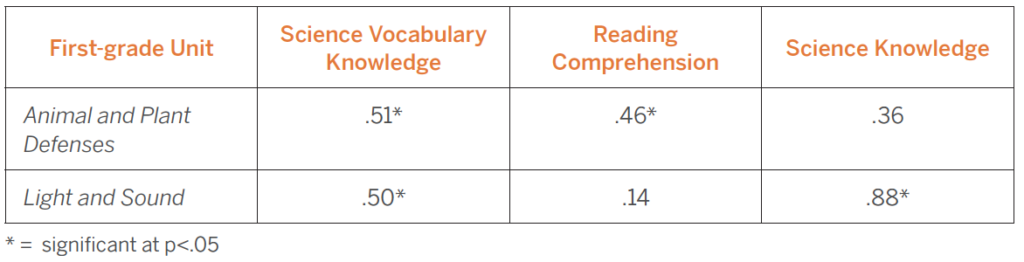
Importantly, students demonstrated substantial growth in vocabulary knowledge and in their capacity to describe challenging science concepts. Furthermore, when asked, all of the teachers who participated overwhelmingly responded that they would teach the Amplify Science units again if given the opportunity. Positive results and feedback were also received from field tests of all other elementary grades, as well.
Findings from grades 6-8 field tests
During field tests for each middle school unit, students responded to an assessment prior to instruction and again immediately upon concluding the unit. Each of these pre-unit and post-unit assessments were scored, and student growth was calculated using percent growth and effect size measures (Cohen’s d).
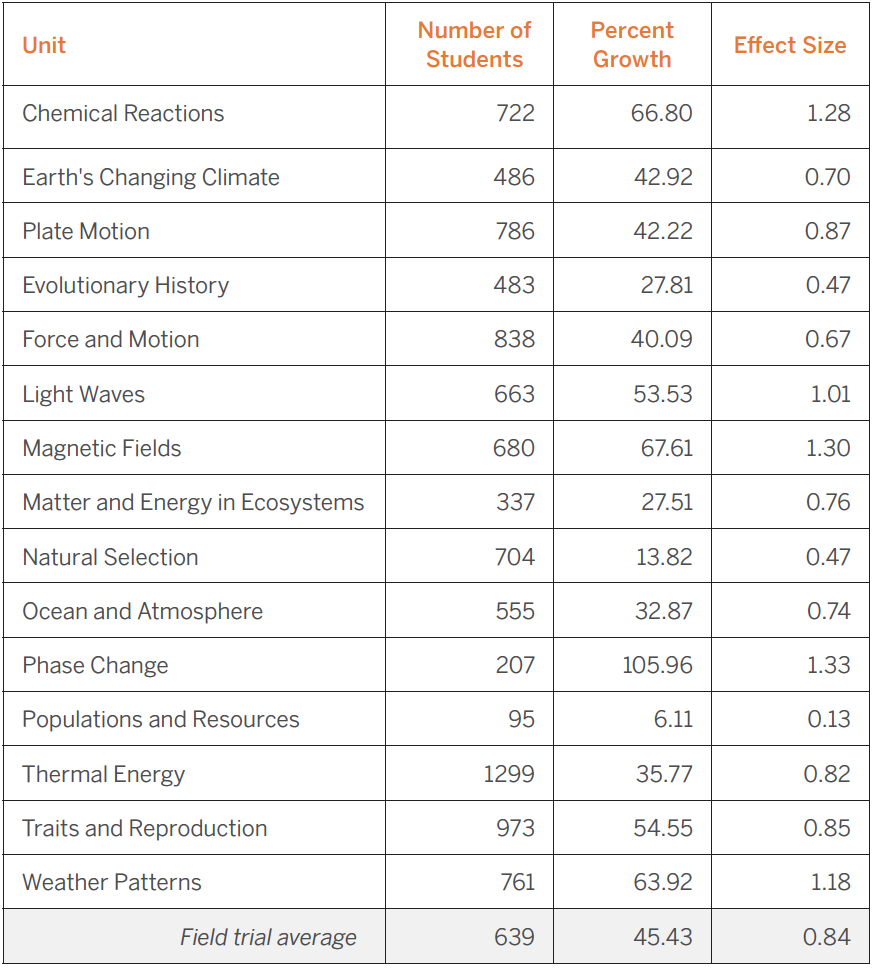
The percent-growth results indicate how much better the class sections did on average between pre-test and post-test. On average, there was a 46 percent growth in student knowledge across the middle school units. Translated into letter grades, that is equivalent to a student increasing two letter grades.
Another way to measure efficacy is by looking at the effect size of the student growth. The effect sizes on student growth during the field tests of Amplify Science middle school units were medium to large. With only one exception (Populations and Resources at 0.129), all units had an effect size on student achievement between 0.5 and 1.4. The average effect size across units was 0.84, which is an excellent outcome.
The percent growth and Cohen’s d effect size measures are given for each unit in the table below. Given these results, the typical teacher might expect student knowledge to increase by 50 percent or more per unit, or roughly a 1–2 letter grade improvement.
Knowledge growth and practical effect sizes
After the field tests were completed, the Lawrence Hall of Science organized the copious amount of teacher feedback and student data (such as the above), and proceeded to revise and rewrite the units, as needed. Each unit underwent several months of revisions, with changes made to lesson content, technology, artwork, media, and kit materials. From initial drafts written in 2014, through the large-scale field tests of 2014–2016, all unit revisions were finally complete for the 2016–2017 school year, just in time for teachers to usher in the new year with a fully-formed, effective, and three-dimensionally designed resources to use with their students.